
The ancient city walls of Lucca are a sight to behold! Once simple defensive structures, these walls evolved alongside the city’s growth, transforming into impressive architectural marvels. Today, they showcase grand arches and innovative construction elements that blend history with modernity, making them a true testament to Lucca’s evolving heritage and ingenuity.
The History of the Walls
The city walls of Lucca, renowned for their impressive preservation, have a rich and complex history that traces back to Roman times. The original Roman walls followed a regular geometric pattern, reflecting the orderly structure of the Roman city. As Lucca’s population expanded and military needs evolved, so did the city’s fortifications.
During the communal period in the 13th century, a new set of walls was constructed to accommodate the city’s growth. This expansion extended primarily towards the east and north, encompassing key areas such as the Church of San Frediano. Via Fillungo, which was once the main thoroughfare (cardo maximus) in the Roman city, evolved into Lucca’s main street. A further extension was added in the 14th century, bringing the urban perimeter to nearly its present-day configuration.

The final and most significant transformation of the walls began in 1513, marking a pivotal era in Lucca’s history. By this time, advancements in military architecture and the increasing use of firearms necessitated a radical redesign. The city became a bustling construction site, drawing on the expertise of specialists from across Italy and beyond. The project, which lasted almost a century, required an immense mobilization of resources and labor.
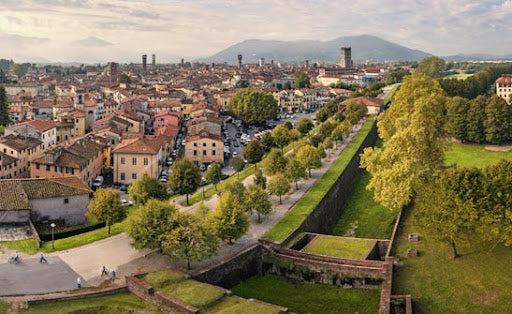
The result of these efforts was a sophisticated set of Renaissance fortifications. The walls were built according to the latest military theories, featuring 10 bulwarks (bastions) and a northern platform, each dedicated to a saint—except one, which was named “Liberty,” reflecting the enduring aspiration of Lucca’s people for freedom. The walls were punctuated by access gates resembling grand triumphal arches, originally just three in number, with two more added later.
Remarkably, these Renaissance walls never faced an outright assault, which is why they remain in such pristine condition. As their military function diminished in later centuries, the walls were transformed into a scenic promenade lined with trees. Today, visitors can walk or cycle along these 4-kilometer-long walls, enjoying panoramic views of Lucca and the surrounding Tuscan landscape while immersing themselves in the city’s layered history.
Experience the Ancient Walls with Accord Tours – Pisa & Lucca Tour
Recent Comments