
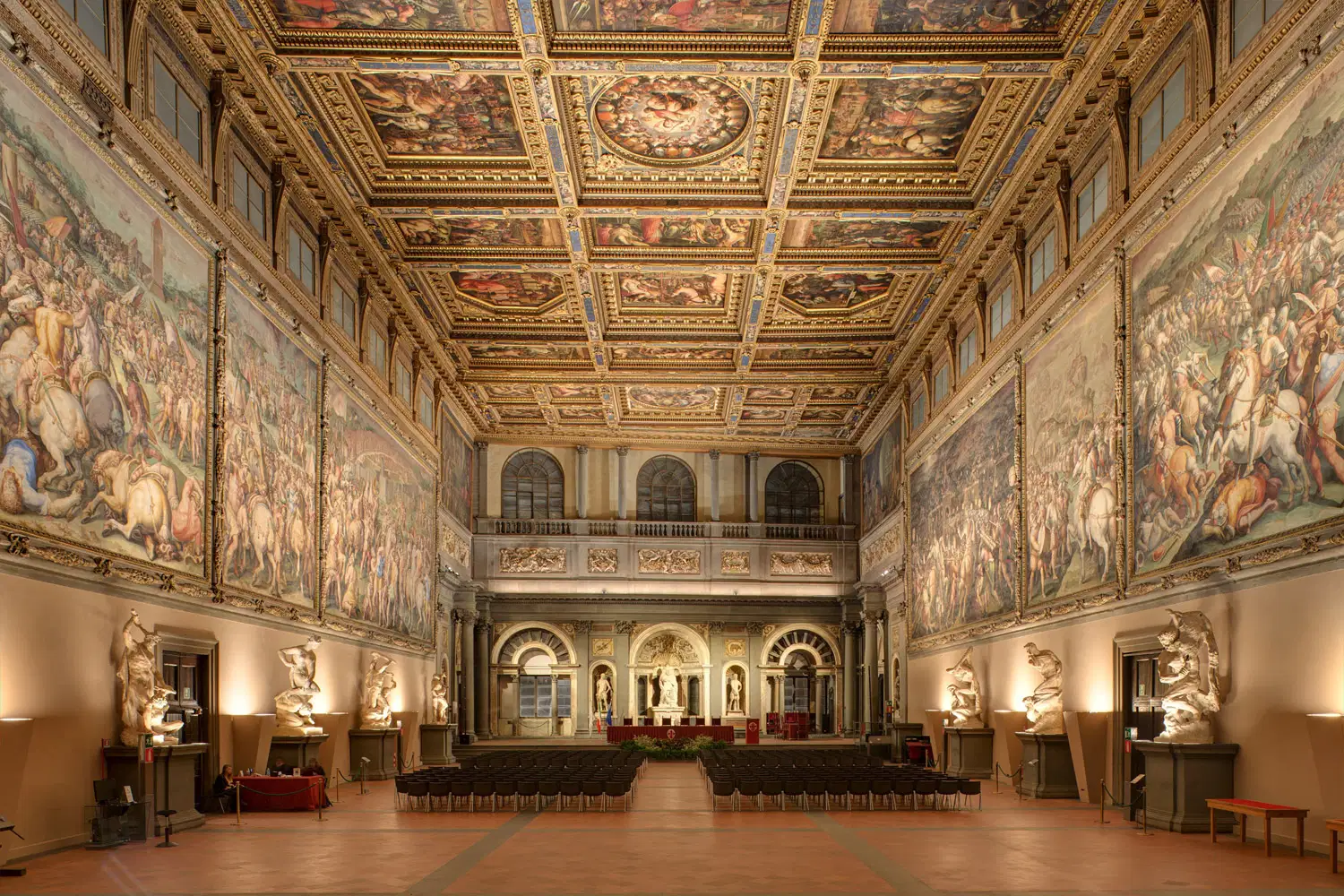
Palazzo Vecchio, located in the heart of Florence, is a monumental building that has stood for centuries as the symbol of the city’s political power. Built in the late 13th century, it was the seat of the Florentine Republic and later transformed into a grand ducal palace by the Medici family. Among its most famous spaces is the Salone dei Cinquecento, a vast hall originally designed for meetings of the Great Council, which was later adorned with magnificent frescoes by Giorgio Vasari, an extraordinary artist and author of the famous biography “The Lives of the Most Excellent Painters, Sculptors, and Architects.” This hall, with its towering walls and intricate artwork, is not just a testament to Renaissance grandeur but also the setting for one of the most fascinating and mysterious tales in art history. With its cryptic message, hidden paintings, and the possible involvement of two of the greatest artists in history—Leonardo da Vinci and Giorgio Vasari—this story is a perfect fit for the spooky season, blending history, intrigue, and unsolved mysteries.
The Story and Mystery Behind “Cerca Trova”
At the heart of this enigma lies a small, almost imperceptible inscription—”Cerca trova” (“Seek and you shall find”)—found on a banner in a fresco painted by Giorgio Vasari in the Sala dei Cinquecento. To understand why this phrase has captured the imagination of so many, we need to trace its roots back to one of the greatest unsolved mysteries in Renaissance art, involving none other than Leonardo da Vinci himself.

The Historical Context: Leonardo da Vinci and the Battle of Anghiari
In 1503, Leonardo da Vinci was commissioned to paint a massive mural depicting the Battle of Anghiari on the walls of the Great Council Hall (now the Sala dei Cinquecento) in Palazzo Vecchio. This battle, fought in 1440 between the Florentines and the Milanese, was a momentous victory for Florence, and the city’s leaders wanted to immortalize it in their seat of power. However, Leonardo, ever the innovator, attempted a new technique for the mural that ultimately failed. His method for drying the paint led to the colors deteriorating, and the unfinished work soon began to decay. As a result, Leonardo’s Battle of Anghiari was never completed, and it appeared to have been lost to history.

Giorgio Vasari and the Redesign of the Hall
Years later, in 1563, Cosimo I de’ Medici, who had become the Duke of Florence, commissioned Giorgio Vasari to redesign the Sala dei Cinquecento to reflect the growing power of the Medici family. Vasari, a prominent painter, architect, and art historian, was tasked with creating new frescoes depicting Florentine military victories, among which was the Battle of Marciano in Val di Chiana. These grand murals would cover the walls where Leonardo had once begun his ill-fated work.
The Mysterious “Cerca Trova”
It wasn’t until much later that art historians and scholars noticed something unusual about one of Vasari’s frescoes. In a high corner of the Battle of Marciano, hidden within a green banner, are the words “Cerca trova”—a cryptic phrase that translates to “Seek and you shall find.” This mysterious message has sparked curiosity and speculation for centuries. What was Vasari trying to say with these words? Why place such a subtle message in a scene of battle? For many, the answer points to one of the greatest mysteries of Renaissance art.
.

The Mystery of Leonardo’s Lost Masterpiece
The discovery of the “Cerca trova” inscription led some historians and art experts to speculate that Vasari may have hidden Leonardo’s Battle of Anghiari behind his own fresco. One of the leading theories suggests that, rather than destroying Leonardo’s unfinished work, Vasari, who was himself an admirer of Leonardo, chose to preserve it by building a new wall in front of it. The phrase “Cerca trova” could then be interpreted as a clue left by Vasari, urging future generations to seek the lost masterpiece hidden beneath his fresco.

Modern Investigations and the Search for Leonardo’s Work
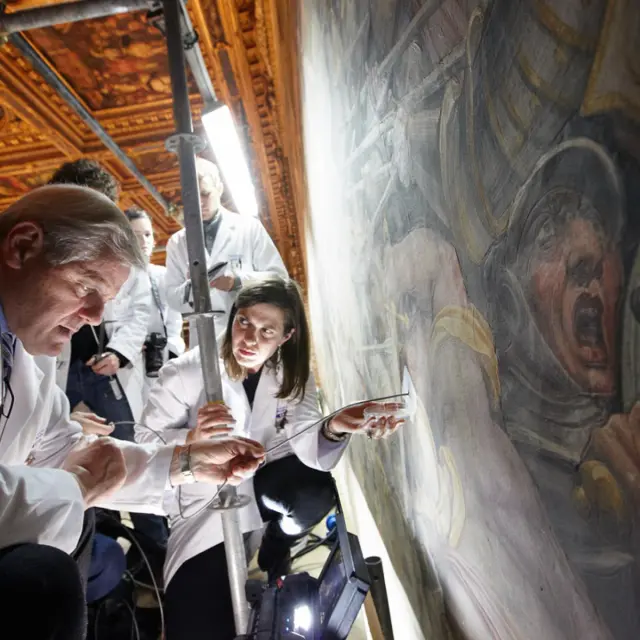
In 1970, art historian Carlo Pedretti first proposed the idea that Leonardo’s mural might still be hidden behind Vasari’s fresco. This theory gained momentum in 2011 when Maurizio Seracini, an engineer and expert in diagnostic techniques for cultural heritage, led a team of researchers to investigate the possibility. Using non-invasive tools like radar and endoscopic probes, Seracini’s team found evidence that there was indeed an air gap behind Vasari’s fresco, suggesting the possibility that something might be concealed there. Even more intriguingly, the team discovered traces of black pigment, similar to that used by Leonardo in his Mona Lisa.
However, the investigation was halted in 2012 due to concerns about potentially damaging Vasari’s frescoes. As a result, the question of whether Leonardo’s Battle of Anghiari lies hidden beneath Vasari’s paintings remains unresolved to this day.
Conclusion: A Perfect Renaissance Mystery
The story of “Cerca trova” continues to captivate both scholars and art lovers alike, weaving together the legacies of two great masters—Leonardo da Vinci and Giorgio Vasari—and the enduring mystery of a lost masterpiece. The cryptic phrase invites us to keep searching, both literally and metaphorically, in the hope that one day we might uncover what lies hidden beneath the surface. In a setting as grand and historic as Palazzo Vecchio, the mystery feels alive, as if the walls themselves are whispering a secret waiting to be revealed. This unsolved riddle, with its layers of history and art, makes it a hauntingly perfect story for this spooky season.
If you are intrigued by this story, we encourage you to book a tour offered by us which deals with this and many other secrets that Florence hides. As an experienced tour operator we guarantee a lot of good memories and quality time in this amazing Tuscan city!
Recent Comments